NASA Earth to Sky Team Northeast Ohio Climate HeroesTeam Northeast Ohio Climate Heroes presents:
Flowing Forward: Climate, Health and Community in the Cuyahoga River Watershed
POSTPONED
Save the date! March 3 - 5, 2027
Visiting sites in Cleveland, Akron, and Cuyahoga Valley National Park
Save the date and stay tuned for applications opening later!
How can our communities work together to create healthier environments and stronger, more sustainable futures for everyone in a changing world?
Join your colleagues in a supportive community of practice to learn about the science of climate change, the social determinants of health, and the unifying role of water, while sharing best practices in science communication and community engagement.
Flowing Forward: Climate, Health and Community in the Cuyahoga River Watershed provides you with a foundation in climate science with an emphasis on the connection between global and local processes and on climate impacts in this region. Participants will discuss and practice proven methods for successful climate communication and connect with the growing Earth to Sky community of practice – over 2400 communicators and scientists from a variety of organizations improving and sharing their expertise on this topic. You will leave the course armed with knowledge about cutting-edge climate science and a plan for bringing the climate story to your visitors in engaging and inspiring ways.
- Offered through the NASA Earth to Sky (ETS) interagency collaboration
- No Tuition Fee
- This course is intended for local participants commuting from home. Any travel expenses are the responsibility of participants and/or their institutions. Free lodging is available if needed, contact the team to request it.
Course Objectives
Upon completion of the course, participants will be able to:
-
Design and execute an action plan to collaboratively produce a climate change education, outreach, and/or interpretative product/program.
-
Engage with the Earth to Sky community, both regionally and nationally, to exchange ideas and expertise and to facilitate implementation of their action plan.
-
Using an Earth Systems Science approach, describe at least one connection between global, regional, and local Earth processes affecting climate in their region.
-
Describe the significance and implications of environmental change in their region to society and natural systems.
-
Describe how global climate-related changes in ecosystems, economies, or society may impact their region.
-
Choose suitable communication strategies for a particular audience based on available audience research and engagement with their audience.
-
Use engaging, audience-appropriate communication techniques, such as metaphor, analogy, visual imagery, storytelling, dialogic questions, or co-creation of knowledge in their product/program.
-
Select relevant, audience-appropriate NASA science content and/or educational/visual elements to use in their product/program.
-
Identify and access credible sources of accurate and timely climate change science relevant to their region/site.
Course Structure
 This course emphasizes experiential learning. It starts with a few distance-learning components that participants are required to complete and an in-person keynote kickoff on the evening of August 25 (dinner provided) prior to attending three days of face-to-face sessions (August 26 - 28) in the Cleveland-Akron area. Participants are expected to be present and fully participate in all of the face-to-face sessions. Approximately four months later, a one-hour webinar will be held for participants to share progress and challenges and receive feedback/assistance in executing their action plans. The collegial atmosphere of this course provides participants with many opportunities to engage with scientists, communication practitioners, and colleagues in collaborative learning.
Pre-Work
These pre-work assignments will be referred to and used during the face-to-face sessions.
Face-to-Face Sessions in the Cleveland-Akron area
- Climate scientists will present climate science in both global and regional contexts followed by discussion sessions to apply that content in participants’ work setting.
- NASA data resources relevant to Northeast Ohio will be demonstrated.
- Field trips to areas of urban sustainability initiatives will serve as case studies illustrating climate science and a model for climate communication and meaningful co-creation with local communities.
- Dedicated time to work with colleagues, coaches, and experienced mentors as part of a regional community of practice to create an action plan for developing a product or program applying course content for use in their site or organization. Participants are encouraged to reach out to internal and external communities as they execute these action plans.
- Opportunities to learn from and talk with local changemakers, medical experts, and world-class climate scientists.
- Learn climate change communication best practices through presentations from experienced interpreters.
- Practice selected communication methodology appropriate to participants’ work settings.
About Earth to Sky
Earth to Sky (ETS) is an ongoing and expanding collaboration between NASA and the National Park Service (NPS) that enables and encourages interpreters, educators, and science communicators to access and use relevant science, data, and educational and outreach products in their work. Since 2004, the partnership has conducted many professional development events on Earth and space science topics, including climate change. https://www.earthtosky.org
Who should attend?
Informal educators and environmental educators from the private or public sector interested in collaborating with others to communicate about public health, community engagement, and climate change.
Requirements
In order to attend this course, participants should have prior experience in communications (i.e., interpretation, environmental education, outreach, and/or public affairs). Individuals must complete the Application Form illustrating their interest and experience in climate change communications. Experience or knowledge of climate science is not a prerequisite.
This workshop happens across different locations over the evening of August 25 and then the days of August 26 - 28. Participants are expected to be able to provide their own transportation to the course location at the start of each day (respectively in Cuyahoga Valley National Park, Cleveland, and Akron). Transport will be provided within each day.
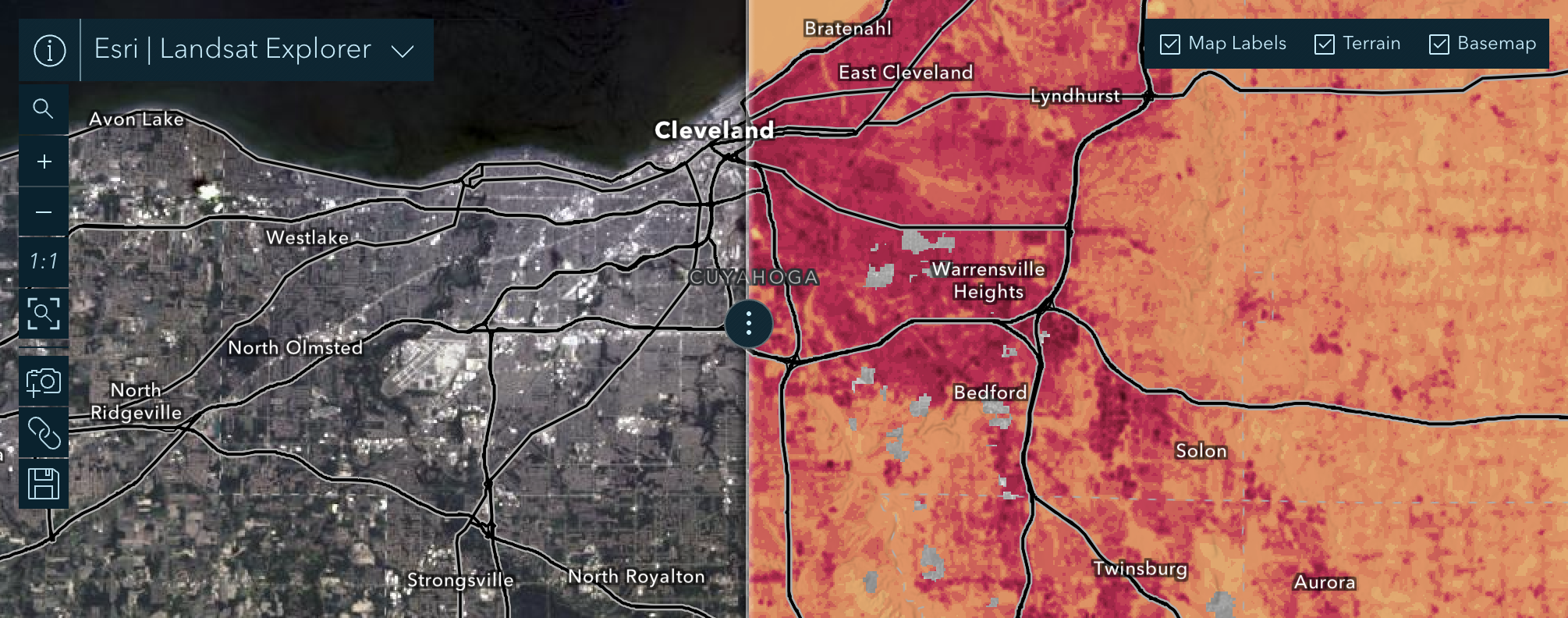
NASA Earth data can bring space-based nuance to your education and interpretation programs. Click the image to explore a zoomable map of the Cleveland area in July 2025, and swipe back and forth between natural color and surface temperature data. The surface temperature data shows hotter areas in deep red, and cooler areas such as the lake, rivers, and forests in pale orange.
Expectations of Participants
- Complete ~4 hours of preliminary assignments outlined above in preparation for the face-to-face sessions.
- Be present and fully participate at the evening keynote kickoff and all three days of face-to-face sessions.
- Create an Action Plan for developing an interpretive, educational, or outreach product or program applying course content.
- Participate in post-course reporting and evaluations, including a one-hour follow-up webinar with fellow course participants.
Selection Process
The course planning team will carefully review and make selections based on information provided in your Application Form. The maximum class size is 25. Those not selected during the first round will be placed on a waitlist to backfill any cancellations.
How to Apply
The application link will be posted here in the winter of 2026-2027.
Cost
The course is tuition-free. Travel expenses are the responsibility of participants and/or their institutions.
Questions?
Contact us at This email address is being protected from spambots. You need JavaScript enabled to view it.